Wednesday, October 20, 2010

Blessed by the phallus on a Himalayan pilgrimage

Chimi LhakhangImage by jfung1 via Flickr

Everyone loves to go for a picnic in Bhutan.

The Divine Madman

Lama Drukpa Kuenley, who came to Bhutan from Tibet, was a great Buddhist saint who used the phallus as a 'medium' to subdue and discipline the malevolent spirits.

The young do not feel intruded when the old tag along with packed lunches. The old have no qualms about sharing high school jokes with their grandchildren as the pines and the cypresses shade their walk to the picnic.

They carry packed lunches in wooden tiffins and tea in Chinese-made flasks with pictures of scary dragons. Picnics are for everyone, as the destination is a monastery.

National dress is mandatory in Bhutan to enter religious sites. So, men can be seen in a Scottish-styled knee-length robe (gho) and women wearing a highly colorful and intricately designed ankle-length dress (kira).

If the climb to the monastery is too inaccessible, then the gho and the kira are stuffed into a backpack along with the lunch.

The picnickers wear jeans, jackets and sneakers and listen to Curt Cobain or Britney Spears from their ear plugs. Some mobile phones scream out loud FM stations playing local Dzongkha songs.

Chimi Lhakhang will not seem far away as you climb up to the monastery enjoying the blend of music, nature and the gurgle of River Punatsangchhu.

Tourists who come to this 14th Century monastery, drive up the hill and have to stop by the rice fields. Then it’s a leisurely walk until the complex wood work on the roof become clearer.

But the first time I went there, I took a different route from the northern side. It was a walk up from Punakha, the former capital of Bhutan, till the culvert on the road from were you could see the monastery of the Divine Madman who subdued demons and women with his enormous phallus.

Then we descend to the banks of the river, walk alongside it till we reach the foot of the monastery hill.

The climb uphill was always punctuated by the stories about the maverick saint, whose blessings the local females and tourists seek to become pregnant. The walk would become smoother with the stories and chants about him.

Here is a smooth prayer, which the saint had apparently taught:

The mind of a Bodhisattva is smooth,
The talk of self-seekers is smoother,
But the thighs of a virgin are smoother than silk:
That is the teaching on the Three Smooth Things.
Women in the group would giggle as the men would further be inspired and continue churning out more outrageous ones.

Lama Drukpa Kuenley, who came to Bhutan from Tibet, was a great Buddhist saint who used the phallus as a ‘medium’ to subdue and discipline the malevolent spirits. The use of phallus was also intended to free up the social inhibitions enforced by the established values.

The blessing of the phallus kept in the monastery is considered sacred especially to barren women. And once they give birth, the child, male or female, is named after the saint, Kuenley.

The phallus of the saint is drawn on walls of houses across the country and one cannot miss it or avoid it.

Elsewhere it would seem scandalous, but that’s what makes Bhutan different and makes even a picnic spiritually satisfying.

I no longer stay near the temple. Almost 70 kilometers away, I stay in the capital of Bhutan now. But I have been there, a couple of times after on taxis and motorbikes.

In the last week of August, I had the opportunity to talk about the temple to a small group of students pursuing a Masters degree in cultural psychology.

We had a lively discussion for about two hours, but I didn’t recite this centuries old Drukpa Kuenley son:

The bed is the workshop of sex,
And should be wide and comfortable;
The knee is the messenger of sex,
And should be sent up in advance

Enhanced by Zemanta

Wednesday, March 3, 2010

Writing for True/Slant

Dear friends.

I have started writing for www.trueslant.com, a news startup with around 275 writers from around the world. It was founded by a former Forbes, Wall Street Journal, and New York Times editor.

You can follow my True/Slant page from your Facebook account here at http://trueslant.com/abytharakan/

I write on topics of South Asian interest with a special focus on Bhutan were I am now stationed as a consultant with the country's only financial newspaper, Business Bhutan.

I also write pieces of personal significance throwing light into the socio-cultural and religious milieu I grew up.

Please keep reading and don't forget to comment.

Warm regards,
aby

Tuesday, January 26, 2010

A chewed necktie, a potbelly and two republic days


It was in 1995 that I last participated in a January 26 Republic Day function, marking the anniversary of the adoption of the Constitution of India. I was a school student then, standing in a queue singing the national anthem as our principal unfurled the tricolor flag.

Today morning, I was a part of the event at the sprawling India House Estate in Bhutan. The Indian Ambassador received the guard of honor of a small column of Indian soldiers dressed in impeccable khaki. Wives of army officials and diplomats gathered, some chastising children who preferred to run along the guard of honor red carpet than stay with their moms.

Meanwhile, I was getting conscious over my blazers and the necktie which I managed around my neck after much effort and help from colleagues earlier the day. This was a deep brownish red tie with golden horizontal stripes, much better than the 1995 blue school tie, the tip of which was chewed, and was occasionally thrust into snotty nostrils.

While standing under the kind winter sun beside well dressed army officials, the tip of my silk necktie looked inviting. “To chew or not to chew,” that was the question.

Then the army band struck the national anthem. I stood in attention as Ambassador Pavan K Verma unfurled the national flag and read out the president of India’s address. I tightened my fists in the required fashion, my burgeoning pot belly struggling out from the tight belt around my pants. As a student, singing the national anthem in full throat was a matter of pride. Today I held my breath, holding my belly in, jealously watching the well toned tummies tucked in army uniforms.

The president, in her address, invoked India’s first prime minister, Pandit Jawaharlal Nehru, who said, “We have to labour, and to work, and to work hard, to give reality to our dreams.”

With less than a week away from my 30th year on this earth, I made a list of things I have to labour and work hard for.

As I munched down a hot samosa at the tea after the event, one item from the list kept ringing: tummy trimming.

Tuesday, December 15, 2009

2012 and yak meat

New Year is still two weeks away, but I made a couple of New Year resolutions last week.

The timing of my resolutions was perfect. It was past 12 midnight and I was watching the apocalyptic movie, 2012. In the movie, a few people representing different nations get to board a huge ship before the entire world is destroyed in huge tsunamis.

I want to be on that ship if such a catastrophe ever happens. But I am afraid I do not have enough money to get a ticket so if I do some good deeds before 2012 I may get a complementary ticket for my contributions to all sentient beings. One such resolution was to write this column and tell young people not to be afraid about 2012.

A friend of mine walked into my office on Wednesday and said she was worried. “My 11-year-old brother says he wanted to get married,” she said. He had watched 2012 and wants to taste the forbidden fruits of life before a tsunami soars from the ocean and pulls down glacial lakes.

Another friend tells that his Class XII son who is writing his board exams said there is no use studying since the world would end soon. The boy, who is poor is Maths, Dzongkha, and Accounts, has demanded his father to open up a video games parlor in Motithang so that he can play games, earn money and drink lots of Coca Cola before 2012. His poor academic records did not stand in the way of preparing a business plan to prove that there is scope for another video games parlor in Motithang.

I am interested to see the Class X and XII results of students from urban schools. If the performance is poor compared to previous years then we can put some blame on the movie.

Another friend in the civil service has given up his ardent desire to go for masters. He has now opened a farm in Facebook Farmville, and has resolved to devote more time to chat with Buddhist girls on Yahoo Messenger and MSN.

Scientists around the world have been telling that the world will not end in 2012. There may be nothing to fear about but I have decided to treat Brown girl, the cute little dog that escorts me to my log cabin door when I return late after work. I fed her for the first time this week with a piece for yak meat.

Monday, December 7, 2009

Coexisting with a soap-eating predator


Recently I moved in to a log cabin on a hill slope of pine trees, autorikshaw-sized rocks, lazy prayer flags and a brook that runs along my bedroom. I started weaving dreams of writing a magnum opus staying in a place like Thoreau’s Walden. I converted a shoe rack used by the previous Japanese tenant into a book shelf.

The arrangement of books had to be special, I had decided earlier. The Tibetan Book of Living and Dying alongside the Bible for quick inspiration before going for work. Next was a bloody thick anthology, which my friend Thea gifted saying if I am ever marooned on an island, I could read it till the Fedex ship comes. This was to be savored on weekends. On top of the rack, in random, were tiny editions of psychoanalytical theory and cultural studies. These would enable me to quickly backdrop any daily experiences with theoretical explanations. For example, to interpret how a girl could force her pony-tailed lover to cut his hair in a blooming multicultural office love affair.

But all plans failed into the second week of my stay with I realized that someone was eating my soaps. It was a huge rat, I learnt, that had fallen in love, first with Pamolive, then Lux and finally Pears. The only explanation I could arrive to from my books was that the rat was anti-capitalist, and must have been the ghost of a food security expert in its previous life. Inspired by the interpretation, I changed my strategy by placing a Mohammad Yunus inspired washing soap produced in a cottage industry. I waited that night peeping through the toilet door for more than an hour. At around 11pm, I heard him or her crawling in through the majestic drain. It climbed up the flush, jumped onto the half-read Audacity of Hope, caressed the Barack Obama cover with its tail and sniffed the Bangladesh-made soap. The rat had found its Ratatouille. But to my surprise it didn’t start eating it. My bushy-brained friend pushed it down to the toilet floor, jumped along with it and rolled the soap to a dry corner. And without any hurry, first smelt it, then nibbled a bit and then started eating.

I felt like an intruder in a place where the rat ancestors lived and ate what they wanted, but now encroached by a man-made toilet. I remembered a newspaper quote by the Nature Conservation Division chief, Sonam Wangyal Wang, from September last year when the human-wildlife conflict discussion was raging. “Peoples are talking about food security. Whose food security are they talking about?” he asked then.

Sunday, December 6, 2009

The porn flu epidemic- column in Business Bhutan

The ongoing debate over the circulation of adult clips, which the police found was leaked from a computer taken for repair, conspicuously missed a point the global anti-pornography movement has been highlighting.

Pornography is violence against women: the movement has argued. This is based on the fact that women featured in adult movies were first driven into sex work, and then were forced before the camera.

The first local media report on the issue suggested that one of the clips (latest reports say four local clips are circulating) was made for commercial purpose. But this theory collapsed when the husband in the clip filed a complaint with the police.

Thereafter, the ‘moral angle’ of the issue was eclipsed by concerns of ‘careful use of technology’. Kuensel, in its November 2 issue, quoting the police, said the “clippings are a result of ignorance and carelessness on the part of the people involved.”

More than a decade back, before such acts of private pleasure because a public spectacle, the small south Indian town I grew up saw very limited exposure to adult entertainment. What was available then, Social anthropologist, Sanjay Srivastava, has named as Footpath Pornography comprising of film actresses’ posters, how-to-do manuals, cheap black and white reprints from magazines like Playboy. Street sellers, in the light of kerosene lamps, would sell vernacular story books with badly printed photographs of shy sex workers.

Then adult video cassettes dominated the scene, along with the rising popularity of Indian magazines like Debonair, which was then edited by Vinod Mehta, the present head of India’s most popular news weekly, Outlook.

Those were the times when technology - public phones, televisions, movie theatres, and camera that uses film – was a public affair. Phones and televisions sat in living rooms, hundreds sat in movie theatres, and camera rolls had to be taken to a studio to be developed. Chances of recording a person’s private moments were slim.

But the former public instruments transformed and could be carried in a handbag, in the form of high-tech phones, digital cameras and laptops. Technology became a private affair. Interestingly it also transformed the nature of personal relationships. Before, if a girlfriend had to prove her love by agreeing to have sex with her boyfriend, now she has to agree to film intimate moments on a mobile phone camera.

Professional adult movies have always censored ‘emotions’ between actors so that the viewer can focus just on the ‘act’ and not worry about relationship woes in what s/he watches. But the circulation of leaked videos, which display not just sex but also emotional intimacy and love between couples, has taken porn-watching beyond basic pleasure needs.

When we measure the culture barometer of a society, along with age-old values, the interplay of private technologies and human desire cannot be ignored anymore.

Tuesday, November 17, 2009

zizek on sacrifice

"what IS sacrifice? The most elementary notion of sacrifice relies on the notion of exchange: I offer to the Other something precious to me in order get back from the Other something even more vital to me (the "primitive" tribes sacrifice animals or even humans so that God will repay them by sending enough rainfall, military victory, etc.)

The next, already more intricate level is to conceive sacrifice as a gesture which does not directly aim at some profitable exchange with the Other to whom we sacrifice: its more basic aim is rather to ascertain that there IS some Other out there who is able to reply (or not) to our sacrificial entreaties.

Even if the Other does not grant my wish, I can at least be assured that there IS an Other who, maybe, next time will respond differently: the world out there, inclusive of all catastrophies that may befall me, is not a meaningless blind machinery, but a partner in a possible dialogue, so that even a catastrophic outcome is to be read as a meaningful response, not as a kingdom of blind chance."

from zizek

Immanuel Levinas on Ethics and Infinity


Without the other, I could not see myself--and even when the other sees me inaccurately or with a bias to do harm, I am still his debtor for what he reveals in me. At times, the enemy may even see me more clearly than does my friend. I am a debtor to him for a perspective about me that invigorates my search to know who I am.

An enemy is also the window of truth. If I am humbled by what my enemy reveals in my heart, then I am better prepared to listen to his claims against me. Our enemies would not be troubling to us if they did not bring to our attention truths that we have not taken into account or articulated well for life. An enemy not only invites us to intimacy but provide clarity to grow in truth.

Monday, November 16, 2009

Snow rain and seeing the chief abbot


It was raining when I woke up.

The music of the rattling drops began when I felt the kerosene heater was getting heated up too much. I was lazy to wake up to turn the heating knob down. I preferred to breathe in the suffocating kerosene smell. But listening to the rain was solace.

This was the first winter rain known to bring snow with it. I opened the curtain, expecting to see flakes on the hill that rises from outside my bedroom window.

“The weather is crazy,” my landlord, who stays in the bungalow around 10 meters away from my log cabin, said. The snow rain pours only in late December or in January.

As I write this, the dark clouds still weigh their options to descend as snow or rain. But there is a general feeling of goodness. On reaching office, a colleague said it rained today as the chief abbot of Bhutan left for his winter residence in Punakha, around 60 kilometers from the capital, yesterday.

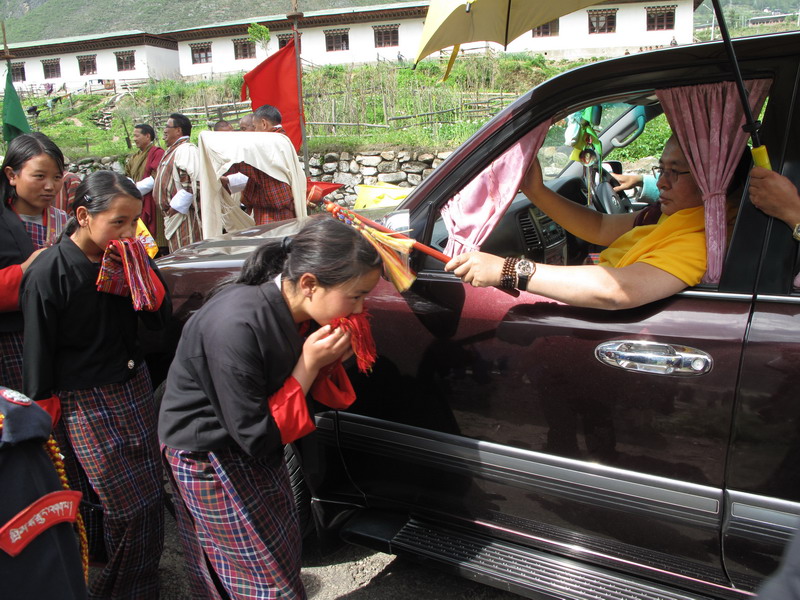
I was fortunate to receive blessings from His Holiness on his onward journey yesterday. I was returning from Punakha, and villagers and school children were lined up along the streets burning pine leaves. I sneaked into a line, stood next to a woman in her late 80s. Tears welled her eyes as she bowed before Trulku Jigme Choeda, who was in his ‘Bhutan’ number plate Land Cruiser. The last time I received blessing from His Holiness was three years back. I was in Punakha then, standing in a line of students.

Tuesday, September 29, 2009

Business Bhutan is out

The past week was hectic with practically no sleep.

But the newspaper is out and we have been getting great comments from different quarters.
I am happy with the feedback we got for the School Bhutan page. Students are really excited, and want their school or institute to be featured on the page at the earliest.

My health also too a downturn with attack from foreign bodies.

The past weekend I slept long hours and am back

Saturday, September 19, 2009

seven days

The seventh day from today, newly democratic Bhutan will get its fifth newspaper.

Business Bhutan, to be launched from capital Thimphu, will be the only financial newspaper in the country. I have been associating with this paper, headed by Tshering Wangchuk, a golfer, break-dancer and repartee-expert, after my two-year stint with the country's first private newspaper, Bhutan Times.

Business Bhutan has a fresh bunch of reporters: from Tshering Yangdon who has been a militia volunteer during the country's flush out operation against terrorists to Phuntsho Wangdi, the tattooed guy who is a national cricket team player.

The newspaper's office is by the only traffic island in Thimphu, a valley surrounded by huge pine trees. Lonely Planet describes this Himalayan town of 90,000 people as the world's only capital without traffic lights.

The central hall of Tashi Taj, the only five-star hotel in the country, will witness the first democratically elected prime minister of Bhutan, Lyonchen Jigmi Y. Thinley launching the 40-page Business Bhutan coming Saturday.

The paper expects, as Arthur Miller said, to be a nation talking to itself.